SFC-Locoformer: adaptive spectral compression at 11.8 dB on DnR
A technical reading of learned spectral compression, local/long-range sequence modelling and the same-protocol 11.8 dB DnR result.
PAPER READING / CINEMATIC SEPARATION
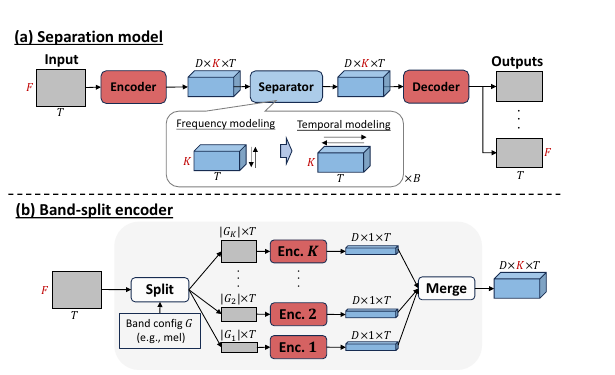
DnR separates a programme mix into dialogue, music and effects. Those sources overlap in both time and frequency, so the problem cannot be reduced to speech activity detection. SFC-Locoformer, BandIt and TIGER-DnR address the same task with different compression schemes, sequence costs and published evidence.
Spectral compression
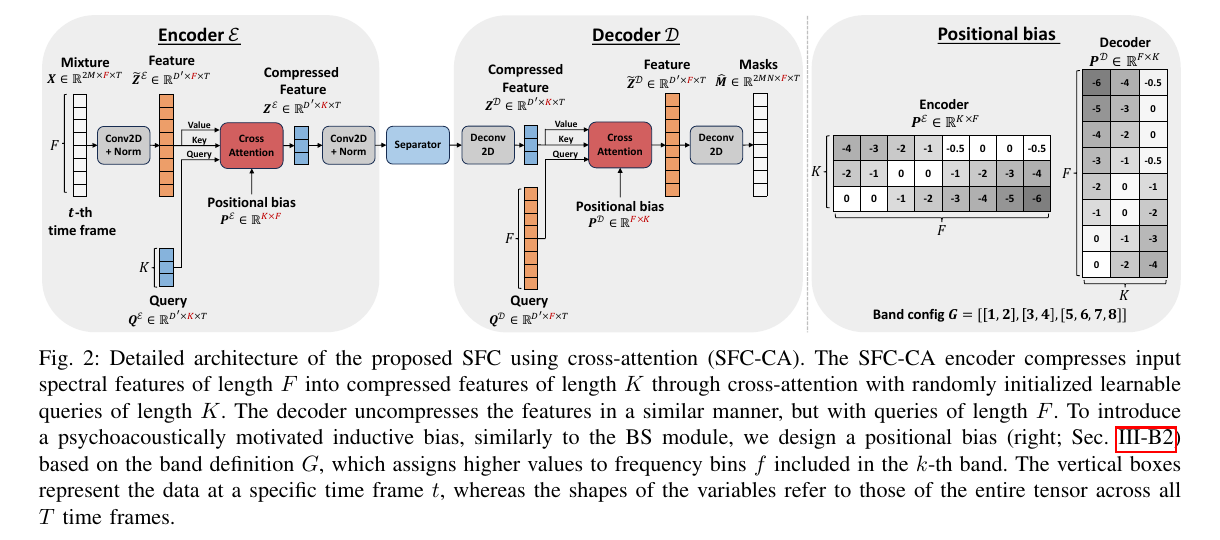
An STFT produces the complex spectrum X(t,f). Giving every adjacent bin the same channel budget spends compute on highly correlated features. SFC learns a projection into a compact spectral axis:
Z(t,k)=Σ_f C(k,f)·[Re X(t,f), Im X(t,f)]
The decoder uses cross-attention to return the compressed representation to target frequency bins. This is not a high-frequency cut: consonant transients, sustained harmonics and broadband effects remain available to the separator.
Local and long-range context
Local blocks model impacts, plosives and drum attacks; communication across windows carries music beds, sentences and ambience. A single dense attention field would make memory grow sharply with duration. Locoformer combines local mixing with economical long-range exchange so that the released medium checkpoint remains practical.
Reading 11.8 dB correctly
Table II reports 11.8 dB for SFC-Locoformer medium and 10.9 dB for BandIt under the same DnR test protocol. The scale-invariant objective is:
SI-SDR=10 log10(||s_target||² / ||e_noise||²)
It supports a within-protocol ranking, not comparisons against MUSDB, another DnR revision or hand-picked clips. The 0.9 dB lead also does not guarantee every film excerpt wins; fricatives, ambience width and effect transients still require blind listening.
Released code and weights
The authors publish SFC-CA, SFC-Mamba and BandIt encoders, the TF-Locoformer separator, and pretrained MUSDB18-HQ and DnR weights. The paper architecture, repository implementation and model-card files can therefore be checked against one another; 11.8 dB still belongs only to the DnR v2 protocol in Table II.
From the DnR benchmark to compressed spectra
Dialogue, music and effects separation gained a comparatively stable target definition after the 2021 DnR Challenge. BandIt later focused modeling capacity on non-uniform frequency bands, while TIGER explored a cheaper sequence model. SFC-Locoformer asks a different engineering question: if neighboring frequency bins are redundant, can they be compressed before spending the model budget on longer dialogue and score structure?
That history is why the three released models belong on one task page without being described as a simple old-to-new replacement. BandIt is a strong band-split baseline, TIGER offers a compute-oriented alternative, and the released SFC medium checkpoint reports 11.8 dB under the same DnR v2 protocol used by Table II. Architecture, weights and evaluation protocol all matter.
Spectral compression as an adaptive operator
Z(t,k)=Σ_f A(k,f|X)·W_f·X(t,f)X(t,f)complex input spectrumA(k,f|X)input-adaptive band aggregationZ(t,k)compressed sequence representation
A is not a fixed frequency-pruning rule. It is an input-dependent aggregation weight, so the shorter k axis leaves more sequence capacity for dialogue, score and ambience across time.
The decoder still queries with non-compressed features to restore every output bin. The equation is an information-flow abstraction; CrossAttnEncoder, CrossAttnDecoder and the adaptive query in the repository are the auditable implementation.
Paper, code and weights can be followed through SFC-Locoformer source / Released DnR checkpoint / SFC paper and DnR table.
How far the shared table reaches
Only rows verified under the same published protocol are ranked here; TIGER-DnR is not inserted into Table II without a matching result.
| Model | Published result | How to read it |
|---|---|---|
| SFC-Locoformer medium | 11.8 dB SI-SDR | highest published value in this protocol; still audit dialogue edges |
| BandIt | 10.9 dB SI-SDR | same-protocol band-split baseline |
| TIGER-DnR | efficiency evidence shown separately | not mixed into a missing table row |
Three listening checks beyond the mean score
On dialogue, listen for sibilants, breaths and distant speech. SI-SDR removes global gain from the comparison, but it can miss metallic edges and damaged room tails. On music, check for speech ghosts; on effects, preserve the continuity of doors, footsteps and ambience.
Broadcast mixes also contain limiting, dialogue ducking and channel fold-downs. A DnR paper protocol does not automatically represent every delivery master; comparisons among SFC, BandIt and TIGER should use the same excerpts and audit dialogue edges, music leakage and ambience continuity separately.
The model does not identify every object in a scene
The effects stem is a broad container. Rain, traffic, applause and foley remain combined, so DnR output is not object-level sound decomposition.
Upstream license conditions still govern deployment and redistribution, even though the task form no longer interrupts the workflow with a model-license lecture.
Papers and public files for SFC-Locoformer source
Model names, numbers and limitations trace to the papers, repositories or model cards below.