Boogu-Image 0.1: inference paths and failure modes across Base, Turbo and Edit
Latent flow matching, few-step distillation and edit preservation across three released checkpoints, with runtime and evidence boundaries.
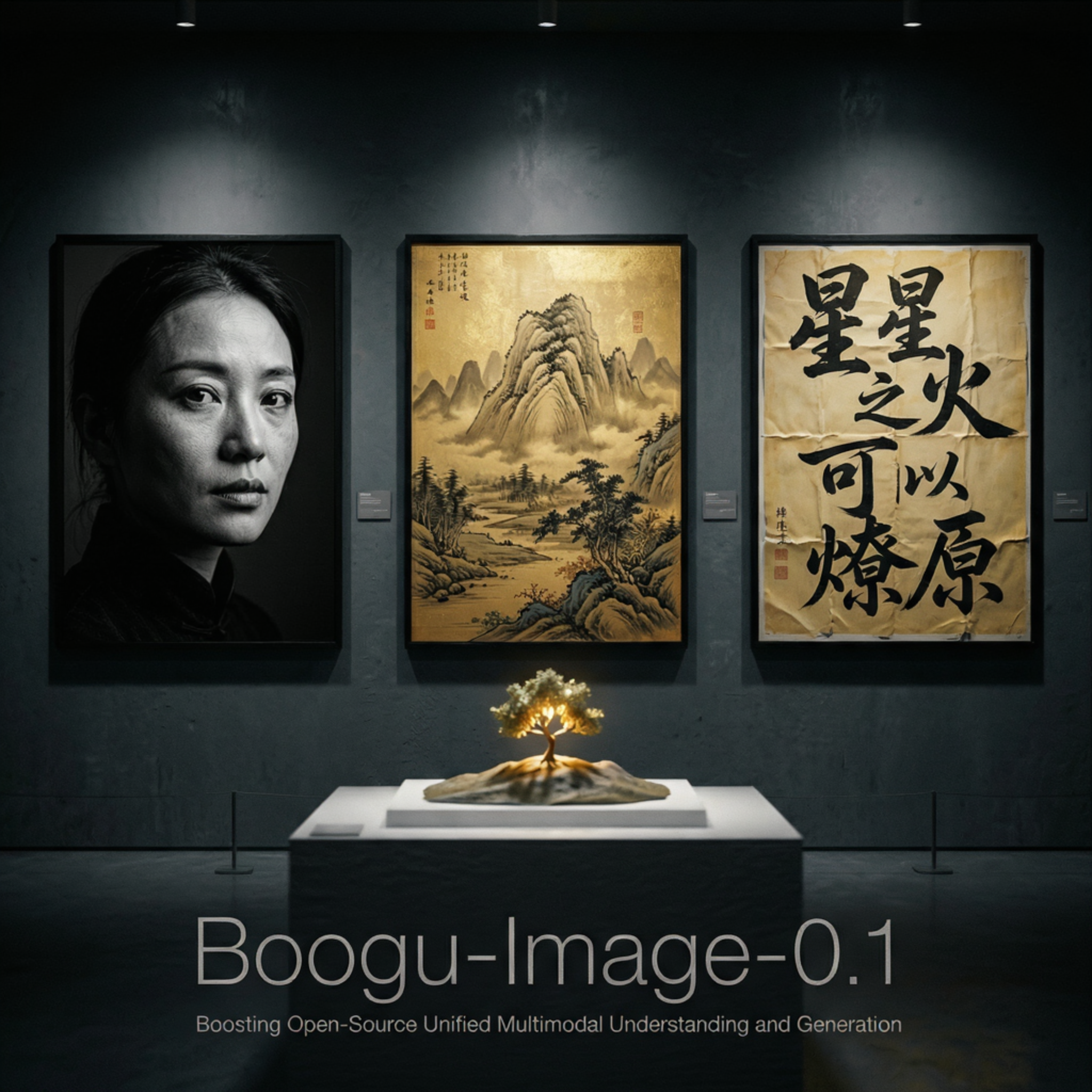
MODEL ANATOMY / GENERATION AND EDITING
Boogu-Image 0.1 releases a base generator, a distilled fast model and a single-image editor. One project name therefore covers three training histories, three sampling contracts and three different ways an output can fail.
Flow matching
The model learns a velocity field between noise and image latents. A compact training objective is:
L=E[t,x₀,x₁] ||vθ(x_t,t,c) − u_t(x_t|x₀,x₁)||²
Base integrates a longer path. Turbo learns a short approximation of that path, so its errors are not simply smaller versions of Base errors. Edit adds an input-image condition and must preserve content that the instruction did not target.
Why the three weights were separated
A base model first learns a usable transport field. A distilled student then compresses that trajectory to roughly four steps. The editor requires paired instruction–image examples and an additional preservation objective. This sequence explains why fewer steps do not automatically mean a more capable model, and why a single-image editor does not imply multi-reference composition.
Failure modes need separate review
Base can preserve fine structure while repeating local patterns. Turbo may harden contours, over-regularize texture or damage small text. Edit needs three checks at once: instruction compliance, subject identity and drift outside the requested region. A fair comparison keeps prompt, canvas and seed fixed.
What the release evidence establishes
The official repository and three model cards establish that Base, Turbo and Edit weights were published with different usage paths. Publisher prompt comparisons describe that release; they do not create a universal leaderboard across posters, portraits, products and multilingual typography.
Why one release contains three checkpoints
Boogu-Image 0.1 ships Base, Turbo and Edit together, which makes them look like simple speed presets. Base keeps a longer generation trajectory, Turbo distills that trajectory to roughly four steps, and Edit adds an input image to the conditioning contract. One project name therefore hides three separate acceptance questions.
The release date also hides the development order. A base model first learns a usable velocity field, a distilled model learns a short approximation, and an edit checkpoint adds paired instruction-image data. Without that history it is easy to claim that fewer steps are universally better or that a single-image editor automatically supports multi-reference composition.

Base and Turbo share an objective, not a sampling path
L_FM=E[t,x₀,x₁] ||vθ(x_t,t,c)−u_t(x_t|x₀,x₁)||²vθpredicted velocity fieldu_ttarget transport pathctext or image condition
Flow matching trains a velocity field from noise to image latents. Base integrates a longer path; Turbo learns a short approximation, so four-step behavior cannot be inferred from Base step-count heuristics.
Edit adds an input-image condition. Acceptance must separate instruction compliance, subject preservation and drift outside the requested region instead of substituting sharpness.
Paper, code and weights can be followed through Boogu-Image source / Boogu Base weights / Boogu Turbo weights.

The differences among the three models
This is an intra-project contract table, not a universal leaderboard built from an internal preference set.
| Profile | Default inference | Primary audit |
|---|---|---|
| Base | multi-step flow matching | detail, composition and long-path stability |
| Turbo | about 4 steps | distillation artifacts, text and small objects |
| Edit | one image plus instruction | instruction compliance and background preservation |
Look beyond sharpness
Base may preserve more detail while still repeating local patterns. Turbo is vulnerable to rigid contours, over-familiar texture and broken small text. Edit must be judged on instruction compliance, subject identity and drift outside the requested region.
A comparison should keep prompt, size and seed fixed across the three checkpoints. A release image demonstrates capability but does not establish stable behavior across posters, portraits, products, dense typography and complex compositions.
Release examples are not a benchmark
The publisher prompt set is useful for reproduction but cannot represent every poster, person, product or multilingual layout. A defensible comparison needs a fixed prompt suite and blind review.
Base, Turbo and Edit require separate sampling records. Step count changes both cost and trajectory error, while the edit checkpoint also needs the input image, instruction and preservation outside the edited region.
Papers and public files for Boogu-Image source
Model names, numbers and limitations trace to the papers, repositories or model cards below.