Qwen3-TTS, Fish S2 Pro, MOSS-TTS and VoxCPM2: four speech-conditioning contracts
Voice design, discrete audio tokens, long-context scaling and zero-shot references compared as distinct inference contracts rather than one score.
SPEECH SYNTHESIS / TECHNICAL COMPARISON
Reading text aloud is only the common shell. These open-weight routes define voice instructions, reference audio, long context and streaming differently; speaker similarity, naturalness and first-packet latency are not interchangeable metrics.
One likelihood, different conditions
A discrete-audio model commonly learns p(a₁…a_T | text, c), where a_t is an acoustic token and c may be a reference speaker, a voice instruction or prior context:
L_AR = -Σ_t log p(a_t | a_<t, text, c)
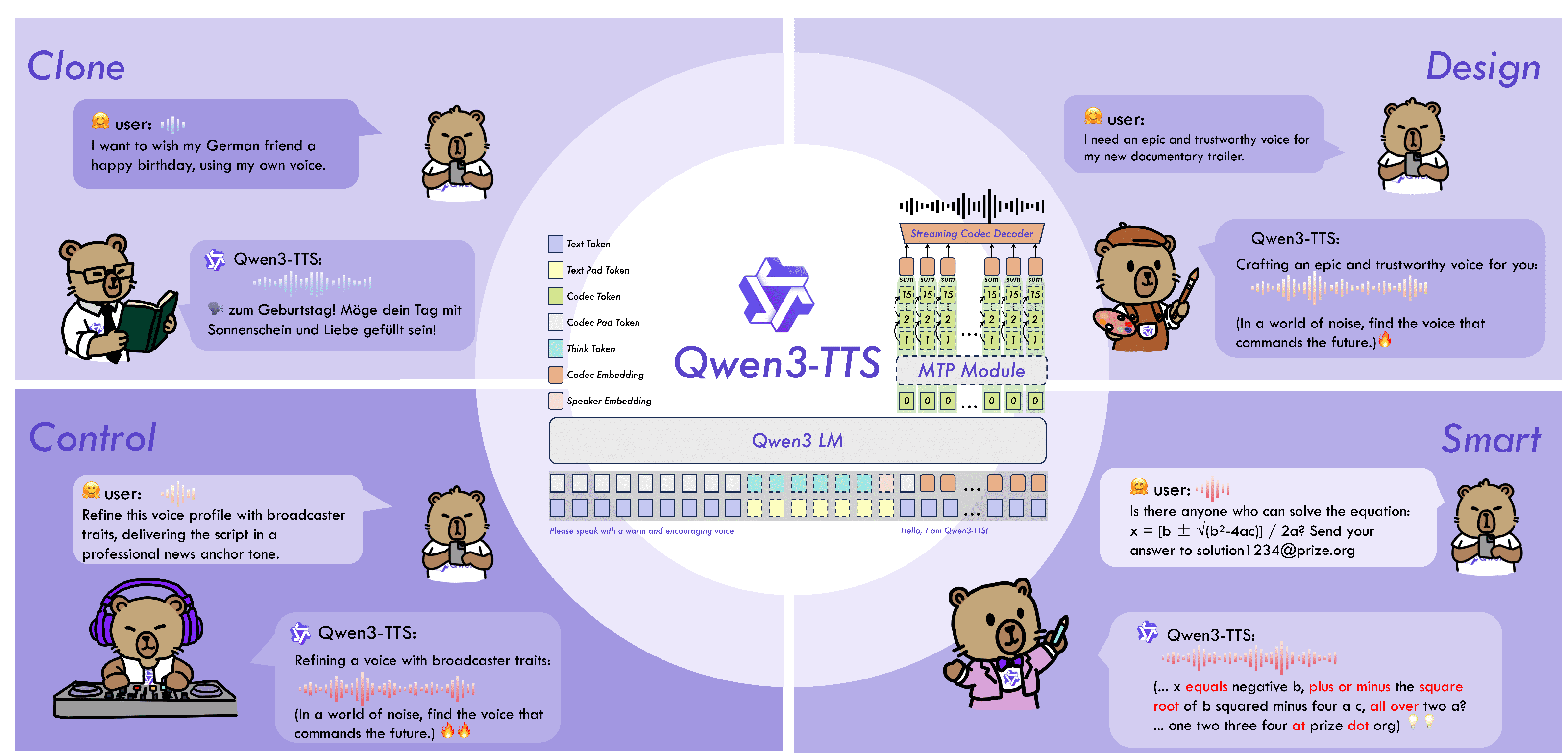
Qwen3-TTS exposes free-form voice design alongside short-reference cloning. Fish S2 Pro provides a high-fidelity discrete-speech route for timbre and prosody checks. MOSS-TTS publishes both an 8B capacity profile and a roughly 100M Nano speed baseline. VoxCPM2 supplies another zero-shot reference and long-utterance path. Their input contracts are therefore recorded separately.
WER, similarity, MOS and latency answer different questions
WER measures content errors, speaker similarity compares embeddings, MOS depends on listeners, and latency separates first audio from full real-time factor. A system can preserve timbre while reading the wrong words, or achieve low WER while sounding like the wrong speaker.
Why cross-project numbers do not form one ranking
The four projects use different corpora, language distributions, reference lengths, raters and compute conditions. Direct comparison requires the same text, prompt audio and decoding setup; publisher tables retain their source labels rather than becoming additive points in a synthetic total.
How acoustic representations evolved
Qwen3-TTS, Fish Speech, MOSS-TTS and VoxCPM all publish speech-generation capabilities, but their conditioning interfaces differ: multilingual instruction and timbre control, codec tokens, long context and prompt audio receive different emphasis. The comparison concerns task scope, not one universal ladder.
Open TTS has advanced across text encoding, discrete acoustic tokens, continuous generation, speaker conditioning and streaming decode. Published MOS, similarity, WER and real-time factors use different corpora, raters and compute conditions; direct ranking requires a shared rerun.
Five evaluation axes for open TTS
Q=(WER↓, SIM↑, MOS↑, T_first↓, RTF↓)WERcontent error rate, lower is betterSIM/MOSidentity similarity and perceived naturalnessT_first/RTFfirst-audio and full-run speed
WER measures word errors, SIM embedding proximity, MOS human preference, and first-audio latency versus RTF cover two latency views. Winning one does not imply winning the others.
Qwen3-TTS, Fish, MOSS-TTS and VoxCPM2 expose different conditioning interfaces, corpora and published evaluations. A direct comparison must fix text, prompt audio, compute conditions and decoding.
Paper, code and weights can be followed through Qwen3-TTS / Fish Speech / MOSS-TTS.

What each speech metric answers
Each row retains its source architecture, metric or task definition; results without a shared protocol remain separate.
| Model | Architecture or evidence | Scope |
|---|---|---|
| Qwen3-TTS | multilingual instruction and timbre conditions | language switches, content and control |
| Fish Speech / MOSS-TTS | codec or long-context routes | repetition, long form and reference contamination |
| VoxCPM | another open generation architecture | naturalness and latency on shared material |

Content, timbre and long-form listening
Check numbers, dates, abbreviations, language switches and long-form omissions before similarity, emotion and prosody. A similar voice can say the wrong words; a low-WER sample can sound like the wrong person.
First-audio latency, full real-time factor and long-form stability need separate reporting. Short-sentence speed does not predict long-form behavior, and parameter count does not determine naturalness or speaker similarity.

Risks left by voice similarity
Cross-project published scores cannot be added. Only common corpora, matching metrics or explicitly source-local results can be compared directly.
Voice cloning requires permission and conspicuous disclosure. Technical capability does not authorise impersonation.
Papers and public files for Qwen3-TTS
Model names, numbers and limitations trace to the papers, repositories or model cards below.