Qwen-Image, Z-Image and FLUX.2 Klein: why three open image lines diverged
A technical history of the 20B MMDiT, 6B single-stream DiT and 9B rectified-flow routes across typography, distillation and multi-reference editing.
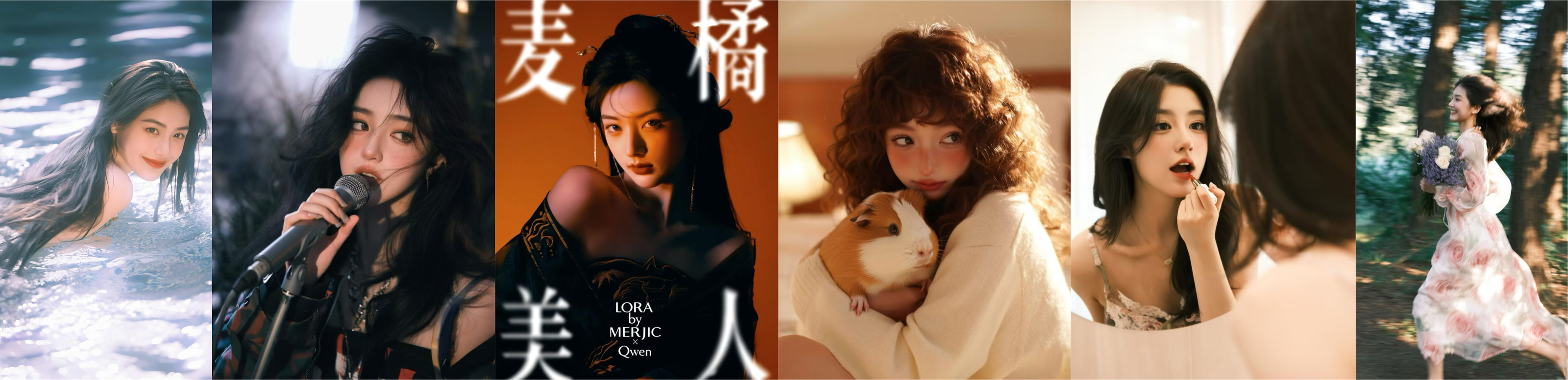
OPEN IMAGE MODELS / TECHNICAL REVIEW
Open image models are no longer differentiated only by how convincing one generated picture looks. Qwen-Image concentrates capacity on complex typography and dual-encoded editing; Z-Image builds a 6B single-stream DiT and distils it to eight network evaluations; FLUX.2 [klein] puts generation and multi-reference editing into a compact four-step rectified-flow model. They belong to the same generation of releases, but spend model capacity on different problems.
Diffusion and flow matching
A compact flow-matching objective is L_FM=E||v_θ(x_t,t,c)-u_t||². Fewer steps reduce function evaluations, but distilled and non-distilled models cannot be compared by step count alone.
Three release routes
Qwen-Image emphasizes complex text rendering and precise editing. Z-Image-Turbo distils the generation trajectory. FLUX.2 Klein adds multiple reference images to its editing condition. Parameter count and step count belong to each project and cannot be ranked without the input type and task.
From image quality to typography and editable identity
Text rendering remained difficult after general image quality improved because a word is not just another texture. Character order, glyph shape, line breaking and layout must agree at once. Qwen-Image addresses this with a large data pipeline and a curriculum that progresses from simple strings to paragraph-level descriptions.
Editing exposes a second conflict: the model must change what the instruction names while retaining identity, material and untouched regions. Qwen-Image encodes the source through Qwen2.5-VL and a VAE for semantic and reconstructive information. Z-Image and FLUX.2 [klein] organize those conditions differently, which is why a shared “image model” label hides important architectural choices.

How spatial tokens change image-generation cost
M_peak≈M_weights+M_text+M_VAE+M_attn(H,W)+M_samplerM_weightsmodel weightsM_attn(H,W)canvas-dependent attention stateM_samplersampler and latent state
Parameter count describes model capacity but does not directly determine the cost of one image. As the canvas grows, attention intermediates and VAE features scale with spatial tokens, while composition, typography and detail also respond to the sampling setup.
Qwen-Image uses a 20B MMDiT, Z-Image a 6B scalable single-stream DiT, and FLUX.2 [klein] a 9B rectified-flow transformer with an 8B Qwen3 text embedder. Canvas cost therefore combines spatial sequence length with very different model widths and sampling trajectories.
Paper, code and weights can be followed through Qwen-Image, Z-Image and the FLUX.2 Klein 9B model card.

Architecture, release lineage and sampling trajectory
The useful comparison is not one aesthetic total. It is how each project organizes conditions, which checkpoint stage it publishes, and what distillation changes.
| Model | Architecture or evidence | Scope |
|---|---|---|
| Qwen-Image | 20B MMDiT; semantic and VAE source encoding for editing | Apache 2.0; generation and separate edit releases |
| Z-Image | 6B S3-DiT; text, visual-semantic and VAE tokens in one stream | Apache 2.0; base, eight-NFE Turbo and edit branches |
| FLUX.2 [klein] 9B | 9B rectified flow plus 8B Qwen3 text embedder; four-step distillation | Non-commercial 9B weights; unified multi-reference editing |

How conditions enter the latent space
Why the final few characters still fail
A generator emits pixels rather than editable character objects. It must infer the requested string, choose its scale and perspective, then reconstruct every stroke in the latent canvas. Longer text leaves less room for local error, and Chinese glyphs add dense stroke structure. Typography training improves that chain without turning the output into a typesetting document.
Resolution gives small glyphs more spatial tokens, but also lengthens the visual sequence and increases attention state. Clearer type and higher compute therefore rise together; a distilled trajectory may also preserve large composition while losing the last few strokes.
Open weights still come with different terms and limits
Qwen-Image and Z-Image use Apache 2.0 repositories. FLUX.2 [klein] 9B is released under the FLUX Non-Commercial License. Downloadable weights therefore do not grant identical rights for commercial use, redistribution or derivative training.
The FLUX.2 model card also states that rendered text can be inaccurate and that the model does not provide factual information. A legible number in an infographic is still generated content, not evidence for the claim printed beside it.
Papers and public files for Qwen-Image
Model names, numbers and limitations trace to the papers, repositories or model cards below.